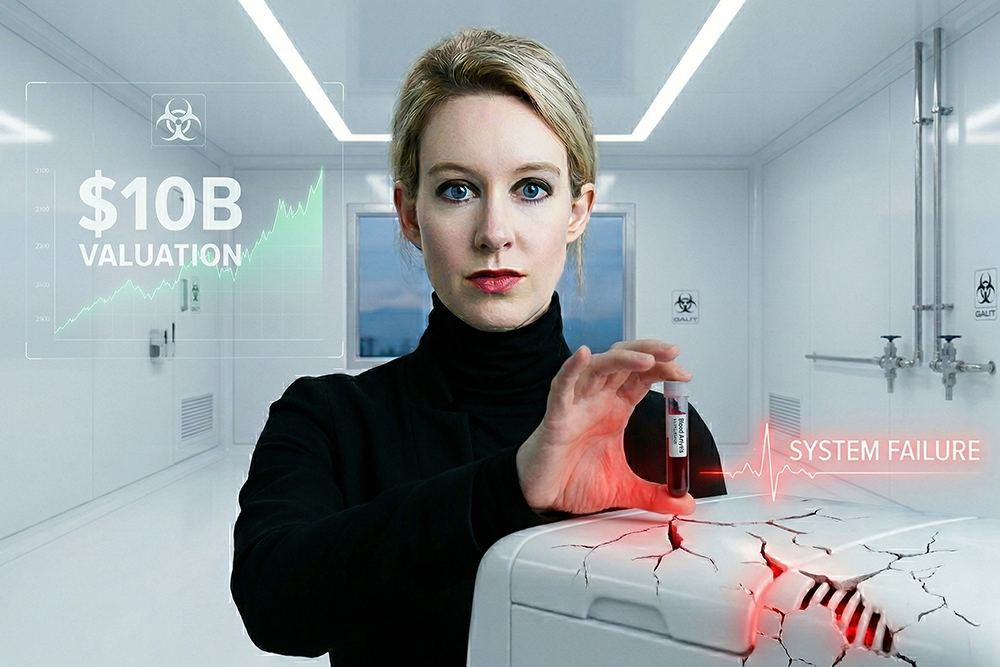
Theranos: How $10 Billion Evaporated When the Room Stopped Telling the Truth
The Theranos story is told most often as a story about fraud.
And it is that. But before it was fraud, it was something more instructive for every entrepreneur who has never committed a crime and never will, a story about what happens when a leadership culture systematically suppresses the signal that the room is not telling the truth.
The technology did not fail suddenly. The trust failed first, slowly, internally, in rooms where the signals were present long before the collapse was visible, and the technology failure was simply the consequence that finally made the internal reality undeniable.
Understanding how that happens is one of the most valuable case studies in modern business. Not because most leaders are Elizabeth Holmes, but because the pattern of suppressed Relational Intuition that destroyed Theranos operates at every scale, in every industry, in organizations that have never considered themselves at risk.
What the Room Was Saying
Theranos promised something revolutionary: hundreds of diagnostic blood tests from a single finger-prick drop. The technology would democratize healthcare, making diagnostics affordable and accessible to people who could not previously afford them.
The story was compelling. The valuation reached $10 billion. The board included some of the most decorated names in American public life.
But inside the company, the room was telling a different story.
Scientists whispered to each other that the results did not replicate consistently. Engineers admitted privately that the machines failed quietly during staged demonstrations. Operations leads watched talented, principled people resign without explanation, which is one of the clearest Relational Intuition signals available: when good people leave suddenly and without apparent cause, the room is communicating something the official story is not.
These were not isolated complaints. They were early relational fractures, the specific signals that Relational Intuition is designed to read: conversations that became guarded where they should have been open, meetings where questions dissolved before they could be fully asked, an energy in the building that felt managed rather than alive.
As Sunil Godse writes in Build Trust. Become the Brand.: “Inside the company, the room told the truth first.”
How the Signal Got Suppressed
The more interesting question is not why the signals existed, as they always exist in organizations where reality and the official story are diverging. The more interesting question is how a leadership culture can systematically suppress them until the gap becomes unclosable.
At Theranos, the suppression happened through a combination of structural and cultural mechanisms.
The board was prestigious but lacked the domain expertise to evaluate the technical claims being made. This is significant because one of the functions of a well-constructed board is to ask the hard questions that internal leadership may be too close to ask. When the board is assembled for prestige rather than expertise, that function disappears.
The valuation reached $10 billion, and the board included some of the most decorated names in American public life, but the calculation that every person in every organization runs – is honesty safer than agreement? – had tilted decisively toward agreement inside the company long before anyone outside knew it.
Inside the organization, the culture made honesty progressively more dangerous. Employees who raised concerns found those concerns dismissed, deflected, or met with subtle social consequences. Over time, no single dramatic moment of suppression was required. A series of smaller moments, each one training the room that candor carries a cost, was sufficient.
The result was an organization where the gap between the internal reality and the public story grew for years, unaddressed, because the room had lost the capacity to surface it.
The Signals That Were Available
What makes the Theranos case particularly instructive is the specificity of the signals that were present and ignored.
The departure pattern. Good people leaving without satisfactory explanation is one of the most reliable Relational Intuition signals in any organization. Talented people who believe in what they are building do not leave quietly. When they do, the room is communicating something important about what it feels like to work there.
The meeting energy. In organizations where the official story and the internal reality are diverging, meetings develop a specific energy: overly smooth, carefully managed, with an absence of the productive friction that characterizes genuine problem-solving.
The pattern of questions. In healthy organizations, people ask challenging questions. In organizations where honesty has become dangerous, questions become clarifying rather than challenging, demonstrating comprehension rather than probing assumptions. The shift in the quality of questions in any room is a signal worth reading.
The departure pattern, the meeting energy, the quality of questions: these are all Relational Intuition signals. The Intuition Scorecard measures how well-developed your Relational Intuition is right now.
The board composition. The choice to fill the board with prestige over expertise was itself a signal, a structural decision that said the organization prioritized the appearance of credibility over the substance of it. This pattern echoes in hiring decisions, partnership choices, and advisory arrangements at every scale.
The Contrast: Ben & Jerry’s
The most clarifying way to understand what Theranos got wrong is to look at a company that faced structurally similar decisions, who belongs in the room, how much does honesty cost, what is the culture actually rewarding, and built something entirely different.
Ben and Jerry’s grew from a small Vermont ice cream shop to a $1.1 billion global brand with expansion into 42 countries by treating every hiring and culture decision as a trust decision. They hired for belonging as deliberately as for skill. They chose suppliers based on integrity over convenience. They built rooms where the energy was alive rather than managed.
The result was a culture where the feedback loop between internal reality and external story stayed intact. Problems could be surfaced and addressed before they became structural. The room kept telling the truth because the room had been built to make honesty safe.
As Sunil writes: “One punished candor. The other protected belonging. The outcomes reflected the difference.”
What This Means for Your Organization
The Theranos collapse was extreme in its scale and its consequences. But the pattern it illustrates, which is a leadership culture that gradually makes honesty more dangerous than agreement, until the gap between reality and the official story becomes unclosable, operates at every scale.
The question worth asking of your own organization is not whether you have a culture of fraud. The question is whether your room is still telling you the truth.
Are the meetings where your most important decisions get made characterized by genuine challenge and productive friction, or by a smooth, managed agreement that feels good but generates little actual signal?
When a difficult topic is raised, does the room open or tighten?
Who are the people who used to speak freely and have become quieter? What changed?
These are Relational Intuition questions. They do not require a survey or an outside consultant. They require the practice of reading what the room is actually communicating, not just what it is saying.
The most expensive business problems almost always begin in a room that stopped telling the truth long before the damage became visible.
The signal was always there. The question is always whether someone trusted it in time.
→ Related: Relational Intuition — Reading the Truth in the Room → Related: The Meeting Where Everyone Agrees but No One Believes → Related: The Four Intuitive Types → Chapter connection: Chapter 14: Relational Intuition → From the book: Build Trust. Become the Brand.