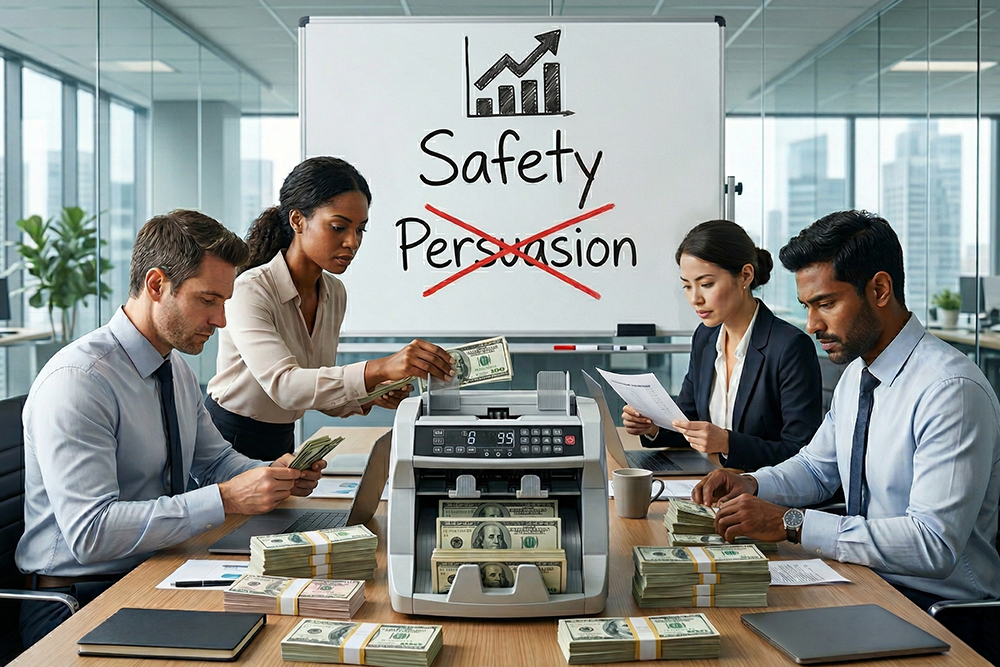
Why Safety Sells Faster Than Persuasion
Most pitches are won or lost before the deck opens.
You can hear it in the small talk and feel it in the way a buyer glances around the room. The slides organize information, but they do not override the intuitive judgment buyers make immediately: whether this feels safe, real, and trustworthy, or whether something is slightly off.
Buyers lead with instinct. They catch the slight pause before a difficult question is answered. The mismatched enthusiasm when a concern is raised. The forced certainty that signals something is being managed rather than addressed. They are not just evaluating the product; they are reading whether you understand the risk they are carrying and whether the outcome you are promising is actually believable given everything they have already sensed about your brand.
When confidence is genuine and grounded, buyers relax. When it is performed, their guard locks in, and no feature list or closing technique will counteract what their intuition has already registered.
Step 5 of the Intuitive Branding Process reframes sales entirely: not as persuasion, but as alignment. Not as closing, but as proving the path.
What Buyers Are Actually Reading
By the time a buyer enters a sales conversation, they have already made an intuitive read about your brand from the marketing, the reputation, and any prior interactions with your team.
Sales does not reset that impression. It confirms it.
Harvard Business Review research on customer trust in sales has found that buyers consistently make their most significant trust assessment in the first few minutes of a sales interaction, based not on product features or pricing but on whether the seller appears to genuinely understand the buyer’s situation and the risk attached to the decision.
Forbes research on sales and brand alignment reinforces that buyers who feel their specific concerns have been heard and addressed, rather than overcome and dismissed, are significantly more likely to close, expand the relationship, and refer others.
Safety, not persuasion, is what closes.
The Intuitive Block Framework
When a buyer hesitates in a sales conversation, it is rarely random resistance. It has a specific structure that your four intuitive types can read.
Sunil Godse calls these Intuitive Blocks, the specific concern, hesitation, or unresolved question that causes one of the four intuitive types to resist moving forward. Understanding which type is resisting tells you exactly what the buyer needs to hear.
Experiential Intuition Blocks are rooted in a past bad experience with a similar product, vendor, or commitment. The buyer has been here before, and it did not go well. What they need is specific proof that this time is different; not a promise, but evidence.
Relational Intuition Blocks are rooted in a lack of trust in the person making the recommendation. The buyer is not yet sure whether you are genuinely interested in their outcome or in closing the deal. What they need is transparency, the specific kind that shows you are willing to name the risks as well as the benefits.
Situational Intuition Blocks are rooted in practical uncertainty about cost, timing, implementation, or logistics. The buyer can see the outcome, but cannot see a clear path to it that fits their current reality. What they need is a believable, specific path, not a roadmap, but a first step.
Creative Intuition Blocks are rooted in an inability to picture themselves on the other side of the commitment. The outcome you are promising sounds good in theory, but does not feel real to them yet. What they need is a vivid, specific picture of what their world looks like after the decision, something they can actually imagine.
When you identify the specific block and address it directly, the buyer stops defending and starts imagining success. At that point, yes becomes relief rather than resistance.
FTX vs Salesforce: Performed Safety vs Genuine Safety
FTX is one of the starkest illustrations of what happens when a brand projects confidence as if confidence were safety.
Every surface signal said the organization was rigorous and mature. But inside every interaction, the intuitive cues were off. Answers arrived suspiciously rehearsed. Simple questions led to complicated detours. Financial disclosures were incomplete in ways that careful buyers sensed before they could prove.
When the truth surfaced, a $32 billion valuation fell to bankruptcy in 10 days. An estimated $9 billion in customer assets vanished. The safety being projected was theater, and the eventual reckoning was swift.
Salesforce rebuilt the entire sales motion around genuine safety from the beginning. Reps were trained to ask buyers to walk them through their actual day before opening a product demo. Contracts were structured with room to start small and expand only on proof. Risks were named openly and early rather than buried in the fine print. The path to the outcome was proven rather than promised.
Instead of persuasion, buyers felt relief. The result was a market capitalization that grew from $3 billion to more than $320 billion, with more than 150,000 businesses running core workflows on the platform and revenue that compounds because buyers choose to expand with what they already trust.
One staged safety. The other delivered it. The difference compounded over decades.
How Step 5 Completes the Process
Step 5 converts the trust built across all four previous steps into committed relationships that grow over time.
The customer who found you through aligned marketing from Step 4, who was served by people hired for genuine fit in Step 3, who was led by an organization with a clear North Star from Step 2, and who came to you because you built signal literacy in Step 1, that customer arrives at the sales conversation with their trust partially built rather than completely guarded.
Step 5 confirms what they have already sensed. And when the confirmation is genuine, when the conversation proves what the marketing promised, the yes becomes relief.
That is not a closing technique. That is a brand doing what it was built to do.
The Intuitive Block framework works best when you know which of your four types is most active in sales conversations. The Intuition Scorecard takes 60 seconds and gives you that read.
→ Related: The 5-Step Intuitive Branding Process → Related: How Intuitive Marketing Earns Trust Before You Speak → Related: The Four Intuitive Types → From the book: Build Trust. Become the Brand.→ Chapter connection: Chapter 21 – Intuitive Sales